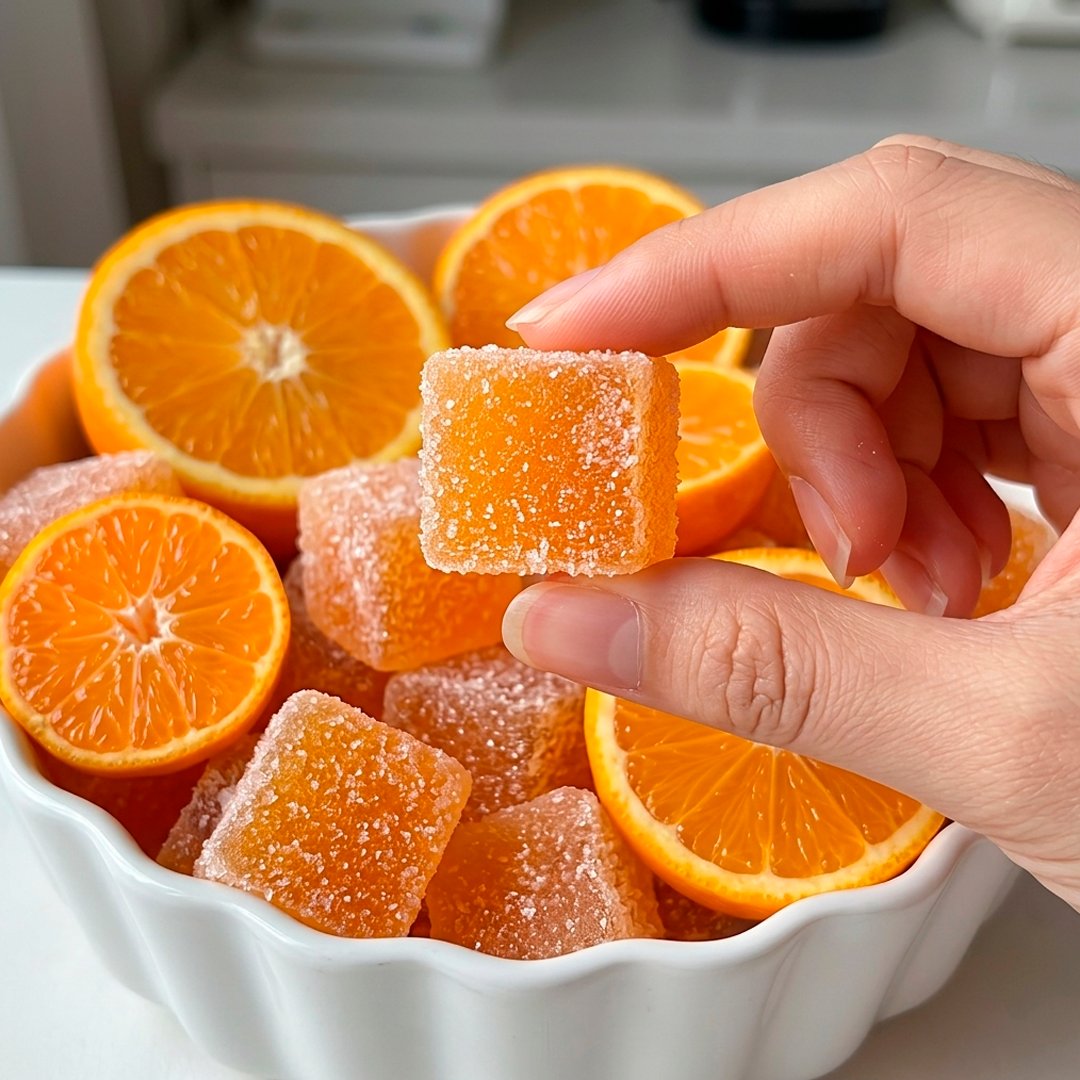
What Makes These Different
Fresh juice. No flavouring. No compromise.
Almost every commercial orange jelly — and many home recipes — uses artificial or concentrated orange flavouring rather than fresh-squeezed juice. The result is a generic citrus note that tastes manufactured. This recipe uses only fresh orange juice as the primary liquid, and the flavour difference is immediate: the bitterness of zest oils, the brightness of citric acid, the natural sweetness — all three simultaneously — in a way that no flavouring agent replicates.
The sugar coating is not decorative. It serves two functional purposes: it keeps the jelly surface from becoming sticky as the cubes warm to room temperature, and it introduces textural contrast — the slight crunch of fine sugar against the soft, yielding jelly — that makes each bite more interesting than jelly alone. The rolling must be done cold, immediately before serving.
Why it works
Acid in orange juice changes how gelatin sets
Fresh orange juice is mildly acidic at pH 3.5–4. This acidity inhibits some gelatin protein bonds, producing a slightly softer set than neutral liquids at the same gelatin concentration. The recipe accounts for this: the ratio is slightly higher than standard, which is what allows the cubes to hold their shape when handled at room temperature.
The coating
Roll in sugar cold, not at room temperature
The sugar coating adheres and stays dry only when the jelly cubes are cold from the refrigerator. Warm cubes have a tacky surface that begins dissolving the sugar before a dry crust can form. Roll immediately before serving — not in advance — for the crunch to survive until the cube is eaten.
What You Need
Four ingredients, all visible in the photograph
Complete Ingredient List
01
Fresh orange juiceThe primary flavour — squeeze just before using
Freshly squeezed only. Do not use from-concentrate — the flavour profile is not comparable. For deepest colour, include one blood orange in the mix.
02
Unflavoured gelatinSets the jelly firm enough to hold cube shape
Use 12–13g per 500ml of fresh juice — slightly higher than for neutral liquids, to compensate for the mild acid content of citrus.
03
Fine caster sugarTwo uses: sweetening the jelly and coating the cubes
A small amount dissolves into the warm juice. A separate quantity is kept dry for rolling. Use the finest grain available for the cleanest coating.
04
Orange zest (optional)Adds the aromatic top note fresh juice can lack
Finely grated zest from one orange stirred into the warm mixture before setting — introduces the essential oils that give orange its distinct aromatic character.
The Method
Four steps — one critical timing decision
01
Squeeze the oranges and warm a portion of the juice
Produce 500ml of fresh juice. Warm approximately half of it to just below simmering. Keep the other half cold — it is added later to preserve the bright fresh flavour that heat would diminish.
02
Bloom gelatin in the cold portion, dissolve in the warm
Sprinkle the measured gelatin over the cold juice and let it bloom for five minutes. Add to the warm juice and stir until fully dissolved. Add sugar and optional zest. Taste — sweetness should be slightly higher than you want in the finished product, as it will read as less sweet once chilled.
03
Pour into a lightly oiled tray and refrigerate
Pour to approximately 3–4cm depth. Cool to room temperature before covering and refrigerating. A minimum of four hours — overnight gives the firmest, cleanest-cutting set.
04
Cut into cubes and roll in sugar immediately before serving
Cut into cubes with a sharp knife. Working quickly while still cold, roll each cube in fine caster sugar until fully coated on all faces. Serve within 10–15 minutes of rolling, while the sugar retains its crunch.
💡
Key Detail — Don't Skip This
Roll the cubes in sugar no more than 15 minutes before serving
As the jelly warms, moisture migrates to the surface and begins dissolving the sugar coating. Cubes rolled more than 20–30 minutes before serving will have a wet, sticky surface instead of the dry crunch that makes these distinctive. Roll, plate, and serve in rapid succession.
"I squeezed eight oranges for this and every one of them was worth it. The flavour difference between this and any commercial orange jelly is not subtle — it is the difference between the fruit and a photograph of the fruit."
— Reader Review · Citrus Drop Community
Full Recipe Access
Get the Sugar-Crusted Orange Jelly Recipe
Exact gelatin ratio for fresh citrus juice, the two-stage juice method, rolling timing, and the zest technique that makes these cubes smell as good as they taste.
Access Full Recipe →
DIGISTORE24 · SPONSORED CONTENT
Advertising Disclosure: Citrus Drop is an independent affiliate content platform. This page contains sponsored content and we earn a commission on qualifying purchases made through our links, at no additional cost to you. All content is for informational and entertainment purposes only. Always follow food safety guidelines when handling fresh citrus juice and gelatin. Individual results will vary.